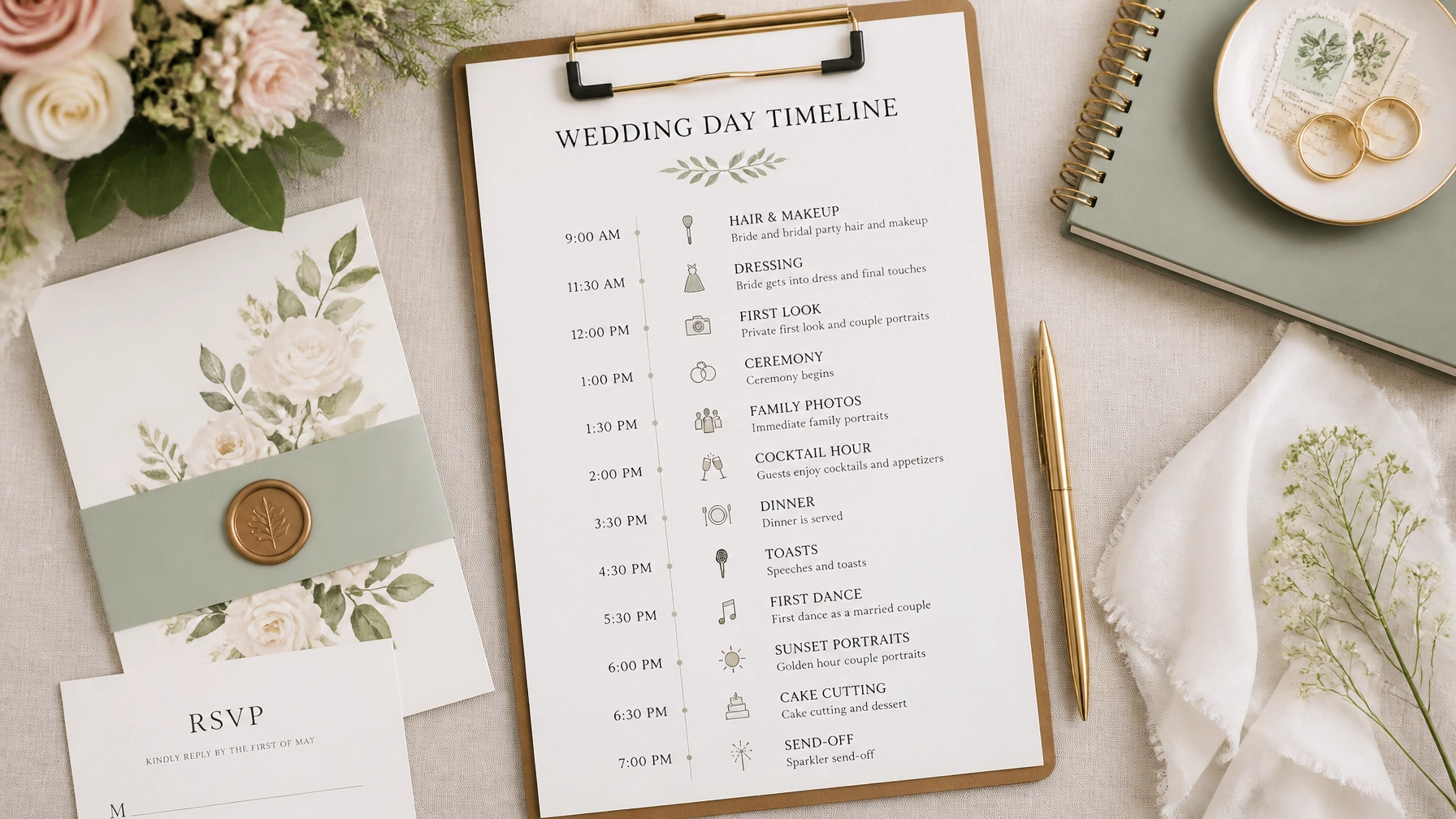
hero_image: https://cdn.marblism.com/tuiztTZ5x6i.webp

If you’ve ever been a guest at a wedding where the ceremony started forty minutes late, the "cocktail hour" lasted two hours, and the dinner was served while the sun was already down, you’ve seen a timeline fail in real-time. It’s awkward, it’s frustrating, and it’s completely avoidable.
In nearly 40 years of serving Mid-Michigan: from the ballrooms of Saginaw to the barns of Beaverton: the team at Team Titus Events has seen it all. We’ve seen timelines that run like a Swiss watch and others that felt like a slow-motion car wreck. The difference isn't usually the budget or the size of the guest list. It’s the planning.
A wedding timeline isn’t just a piece of paper for your vendors; it is your sanity’s savior. It is the invisible backbone of your day that allows you to actually enjoy the celebration instead of acting as a panicked project manager in a white dress or a tuxedo.
The Buffer Time Most Couples Forget
The biggest red flag in any wedding plan is a schedule that is "to the minute." Life doesn't happen to the minute, especially on a wedding day in Central Michigan. If you plan for travel from a church in Midland to a reception venue in Bay City to take exactly 22 minutes because that’s what Google Maps told you on a Tuesday morning, you are setting yourself up for a disaster.
You need to build "realistic" buffers into every transition. We’re talking about the 15-minute window for the bridal party to actually get into the limo. The 10 minutes it takes to wrangle Aunt Linda and Uncle Bob for family formals. The extra time needed if a tractor is moving slow on a two-lane road near Clare.
Practical advice: Take your estimated travel time and add 15 minutes. Take your hair and makeup estimate and add 30 minutes at the end. These cushions aren't "wasted time"; they are the breathing room that prevents you from feeling rushed. When you feel rushed, you look stressed in your professional photography, and that’s a mistake you can’t undo later.
Mid-Michigan Logistics: Beyond the GPS
Planning an event in our neck of the woods comes with its own set of "real-world" challenges. If your wedding falls on a Saturday in the fall, you aren't just competing with other weddings; you’re competing with game-day traffic if you’re near Mt. Pleasant or East Lansing.
Weather variability is another factor. In Michigan, we can have a frost in the morning and a 70-degree afternoon in May. If your ceremony is outdoors, your timeline needs a built-in "weather call" window. You need a polished plan for moving guests inside without it feeling like a fire drill.
When we handle officiant services, we always look at the lighting. If you’re planning a sunset ceremony in October, you have a very narrow window before the temperature drops and the light disappears. If the ceremony starts 15 minutes late, your "golden hour" photos are now "pitch black" photos. Build the timeline around the sun, not just your preference.
The Hair and Makeup Trap
Ask any veteran wedding photographer what causes the most delays, and they will all say the same thing: hair and makeup. It’s the number one reason ceremonies start late. It isn’t usually because the stylists are slow; it’s because the bridal party underestimates how long it takes for six people to get "ready-ready."
Print this: Your hair and makeup should be 100% complete at least one hour before you need to leave for the ceremony or start your first look. That hour is for eating a snack, drinking water, and getting into your attire without breaking a sweat. It also allows your photographer to get those crucial "getting ready" shots without having to dodge a curling iron or a makeup brush.
The First Look: A Practical Decision
There is a lot of sentimentality around the "first look," but let’s talk about it from a tactical perspective. Choosing to do a first look is the single best way to protect your reception time.
If you do a first look, you can knock out your couple portraits, bridal party shots, and often your immediate family photos before the ceremony even begins. This means that once the "I dos" are done, you can actually go to your cocktail hour. You can eat the appetizers you paid for. You can talk to your guests.
If you wait until after the ceremony for photos, you are essentially disappearing for 90 minutes while your guests sit in a reception hall waiting for something to happen. This often leads to the "awkward reception" phase where the energy dips, and your DJ has to work twice as hard to get it back.
Coordination Between the DJ and the Kitchen
A great reception flow is a choreographed dance between the entertainment and the catering staff. This is where having a one-stop shop like Team Titus Events really shines. When our DJ, photographer, and photo booth team are all on the same page, the night feels seamless.
The worst thing you can do is have your DJ announce the first dance while the catering staff is still clearing salad plates. Or worse, having the cake cutting happen while half the guests are outside at the photo booth because they didn't know anything was happening.
A realistic timeline accounts for the "service time" of the meal. A plated dinner for 200 people takes longer than a buffet. Your DJ should be in constant communication with the banquet manager. If the kitchen is running 10 minutes behind (which happens), the DJ can extend a cocktail set or move a speech up to keep the guests engaged.
Why the "One-Stop Shop" Works
Managing five different vendors with five different ideas of a "timeline" is a recipe for a headache. The photographer wants you for sunset photos at 8:15 PM, but the DJ has the bouquet toss scheduled for 8:20 PM, and the caterer wants to pull the late-night snack out at 8:30 PM.
By using our Mid-Michigan event services, you’re getting a team that works together every weekend. We don't have conflicting agendas. We have one goal: making sure your day is perfect. Our photographer knows exactly when the DJ is going to dim the lights for the first dance. Our officiant knows exactly where the photographer needs to stand to get the kiss shot. This level of internal coordination is the "secret sauce" to a stress-free wedding day.
Action Steps for Your Timeline
- Choose your ceremony time first. Everything else scales from there.
- Work backward from dinner. Ask your caterer how long service takes, then work backward to the grand entrance and cocktail hour.
- Build your buffers. Add 10-15 minutes to every transition.
- Consult your pros. Don't guess how long photos take. Ask your photographer. Don't guess how long it takes to seat 150 people. Ask your DJ.
- Distribute the plan. Once the timeline is set, make sure every vendor has it.
Final Thoughts: Be Present, Not Busy
The ultimate goal of a wedding timeline is to allow you to stop thinking. On the morning of your wedding, you should be able to hand your phone to a bridesmaid and just follow the instructions of your professional team.
If you’ve done the work to build a realistic, polished, and practical schedule, the day will move with a natural momentum. You won't be looking at your watch; you'll be looking at your partner. You won't be worrying about the caterer; you'll be dancing.
At Team Titus Events, we’ve spent nearly four decades perfecting the art of the wedding day flow in Michigan. We know the pitfalls, we know the shortcuts, and we know how to handle the "unforeseen" without you ever knowing there was a problem. Trust the process, trust the timeline, and most importantly, trust the experts who are in the trenches with you.
Ready to start planning a day that actually runs on time? Contact us today to see how our full-service team can handle the details while you enjoy the moment.
Leave a Reply